
Digital Innovation Journey

Table of Contents
- Part I - Why Digital Products Fail Before They Break
- Part II - The Digital Innovation Journey as a Decision Lens
- Part III - The Drivers That Shape Product Fate
- Part IV - Seeing Structural Imbalance
- Part V - Decision Gates and Product Mortality
- Part VI - Regulated and High‑Consequence Environments
- Part VII - Leadership Posture
- Appendix - Boundary Conditions
- Intellectual Property and Use
Part I - Why Digital Products Fail Before They Break
1. The Hidden Cost of "Successful" Digital Initiatives
Most digital products do not fail loudly at the beginning. They fail quietly, while everything still appears to be working.
Early milestones are met. Usage grows. Stakeholders feel momentum. Delivery narratives remain positive. At this stage, organizations often conclude that risk is under control.
This conclusion is almost always wrong.
What appears as success is frequently the visible side of an asymmetric system. Features advance. Rollouts expand. External validation increases. Meanwhile, the underlying structure that must sustain the product over time remains uneven, deferred, or undefined.
The cost of this imbalance is not immediate failure. It is irreversibility.
By the time operational pressure, regulatory scrutiny, or scale exposes the weakness, the decisions that created it are no longer recoverable without disproportionate cost. The product is not broken — it is locked in.
Digital initiatives rarely collapse because teams made poor technical choices. They collapse because leadership interpreted early success as proof of structural soundness.
2. Digital Products Are Not Projects
Projects end. Digital products do not.
A project has a defined scope, a delivery horizon, and an acceptance moment. A digital product operates continuously, accumulates users, gathers data, and becomes embedded in organizational and customer behavior.
Treating a digital product as a project creates a structural mismatch from the first decision. Delivery milestones become proxies for health. Completion replaces sustainability as a success criterion.
This mismatch does not manifest immediately. It emerges gradually, as the product continues to operate beyond the boundaries the project was designed to support.
The longer a digital product is managed with project assumptions, the more invisible risk accumulates. The organization believes it has delivered something complete, while in reality it has only delivered something exposed.
At scale, this confusion becomes expensive. At regulatory scrutiny, it becomes dangerous.
3. Decision Delay as a Leadership Failure Mode
In digital environments, not deciding is still a decision.
When leadership avoids explicit product decisions — whether to continue, stop, harden, or constrain — the organization defaults to continuation. Resources remain allocated. Scope expands incrementally. Commitments solidify.
This default is rarely intentional. It is the result of diffused ownership, optimistic bias, and the belief that more data will eventually clarify the right path.
In practice, more data usually arrives after the critical window for decision has closed.
Decision delay allows structural imbalance to persist long enough to become normalized. What began as a temporary asymmetry turns into a permanent constraint. By the time leadership intervenes, the cost of reversal is framed as unacceptable.
At that point, the organization is no longer choosing a direction. It is defending past decisions.
Part II - The Digital Innovation Journey as a Decision Lens
4. What the Digital Innovation Journey Is - and Is Not
The Digital Innovation Journey exists to expose leadership decisions that shape digital product outcomes long before failure becomes visible.
It is a decision lens.
It is not a methodology to adopt, a maturity model to complete, or a framework to implement. It does not prescribe steps, roles, or tooling. It does not optimize delivery.
Its purpose is narrower and more uncomfortable: to make decision ownership explicit, to surface structural imbalance early, and to remove the illusion that outcomes are accidental.
When applied correctly, the Digital Innovation Journey does not tell leaders what to do. It shows them what they have already decided — and what those decisions imply.
5. The Four Product States
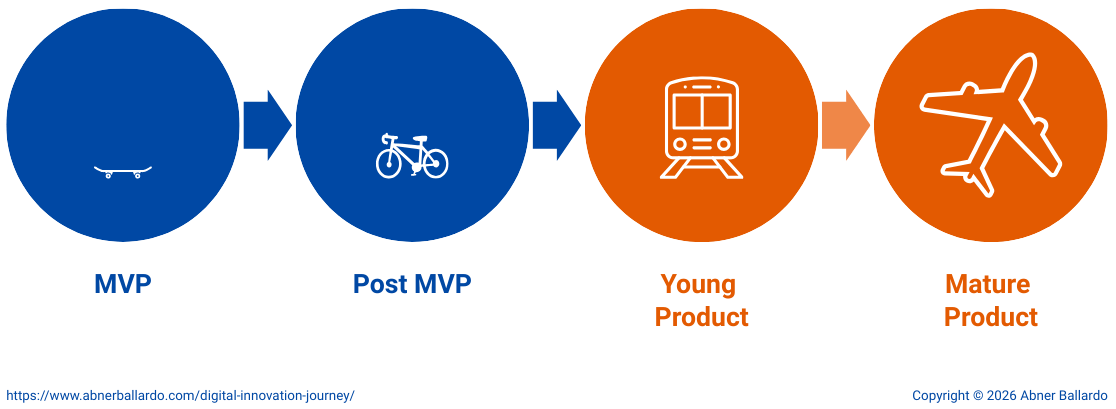
Digital products evolve through distinct states, each defined by a different leadership obligation.
An MVP is not a product. It is a disposable hypothesis designed to test whether an idea deserves further investment. Its value lies in learning, not durability.
Post-MVP exists to force a decision. It separates early enthusiasm from sustained value and confronts leadership with a binary choice: proceed or stop.
A Young Product has survived validation and begun to accumulate real operational pressure. Growth exposes weaknesses that were previously invisible. Balance becomes more important than speed.
A Mature Product is not old. It is structurally complete. It is resilient under stress, predictable under load, and governable under scrutiny. Maturity enables change; it does not prevent it.
Confusing these states — or allowing products to linger between them without decision — is a leadership failure, not a delivery one.
6. Why Products Do Not Evolve Evenly
Digital products do not grow symmetrically.
Some dimensions advance faster than others. Features accelerate. User experience improves. Rollouts expand. Other dimensions — operational resilience, auditability, architectural clarity — lag behind.
This imbalance is not inherently problematic. Early asymmetry is often necessary.
The risk emerges when imbalance persists without acknowledgment. When visible dimensions continue to accelerate while non-visible ones remain deferred, the organization mistakes progress for health.
At a certain point, imbalance stops being temporary. It becomes structural.
The Digital Innovation Journey exists to make this moment visible — before imbalance hardens into irreversible risk.
Part III - The Drivers That Shape Product Fate
Digital products do not fail because one thing goes wrong. They fail because multiple forces evolve at different speeds, under different incentives, and with unequal visibility.
The Digital Innovation Journey groups these forces into four driver categories. They are not phases, steps, or workstreams. They are concurrent lenses that shape how a product evolves — whether intentionally or by default.
Leadership rarely decides to neglect any of them. What changes is attention.
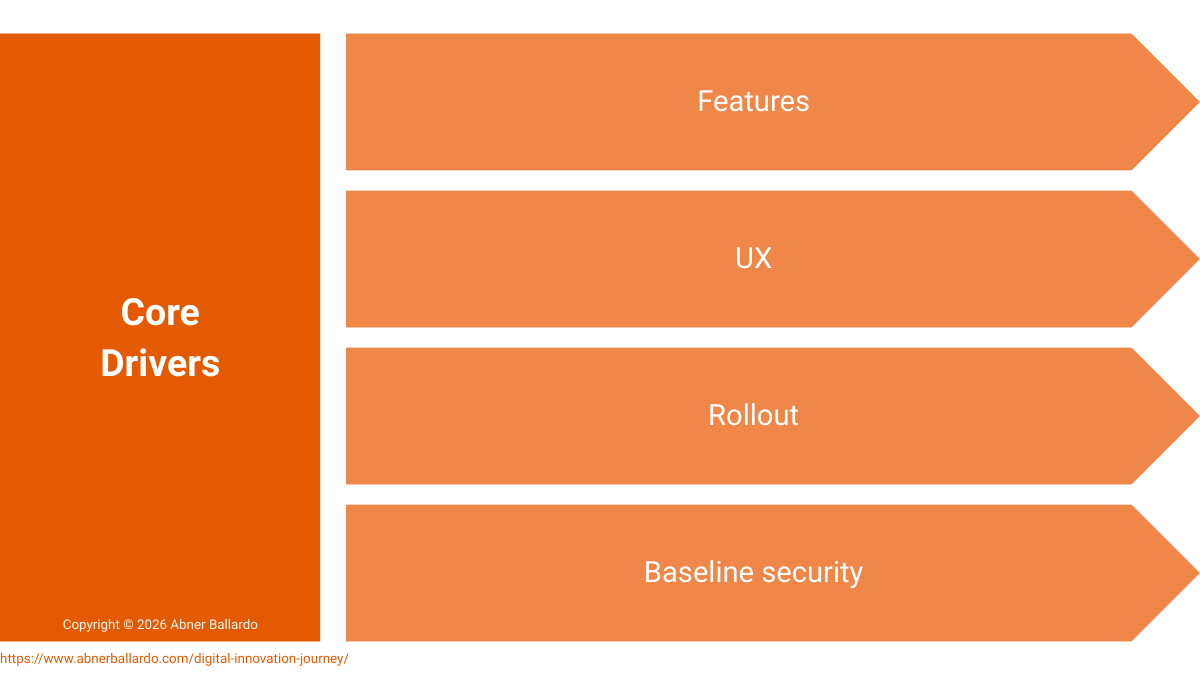
7. Core Drivers: What Everyone Sees First
Core Drivers are the most visible dimensions of a digital product. They are easy to explain, easy to demonstrate, and easy to celebrate.
Features advance. User experience improves. Rollouts expand. Early security assumptions appear sufficient.
Because these dimensions are directly observable, they become the dominant signals of progress. Success narratives form around them. Roadmaps reinforce them. Investment follows visibility.
This creates a predictable distortion. Core Drivers advance faster than everything else — not because leaders consciously prioritize them, but because they are the only dimensions everyone can see.
When Core Drivers accelerate without corresponding attention elsewhere, organizations mistake motion for momentum.
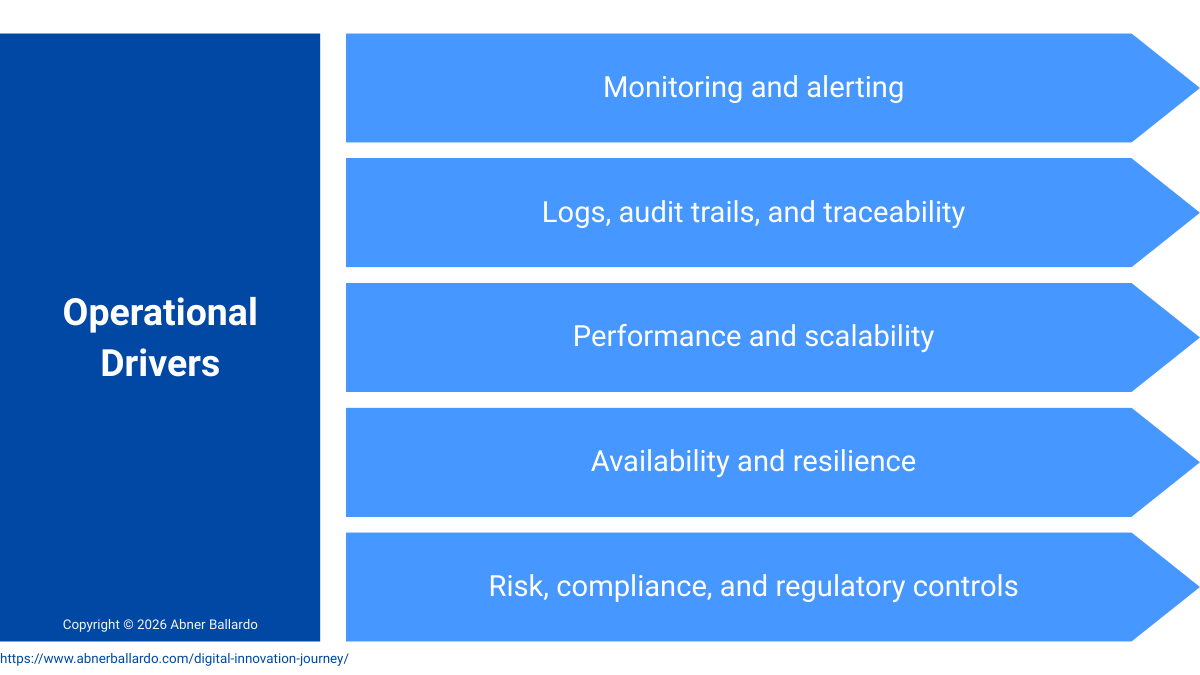
8. Operational Drivers: What Fails Loudly and Late
Operational Drivers determine whether a digital product can operate safely, predictably, and defensibly over time.
They include monitoring, auditability, performance under load, availability, resilience, and the continuous execution of controls.
These dimensions are mostly invisible when they work. Their absence becomes visible only during incidents, audits, regulatory reviews, or reputational events.
Because failure arrives late and publicly, operational weakness is often discovered externally — by customers, regulators, or the market.
By the time these failures surface, the decisions that created them are rarely recent. They are the cumulative result of early trade-offs made when operational concerns were considered premature.
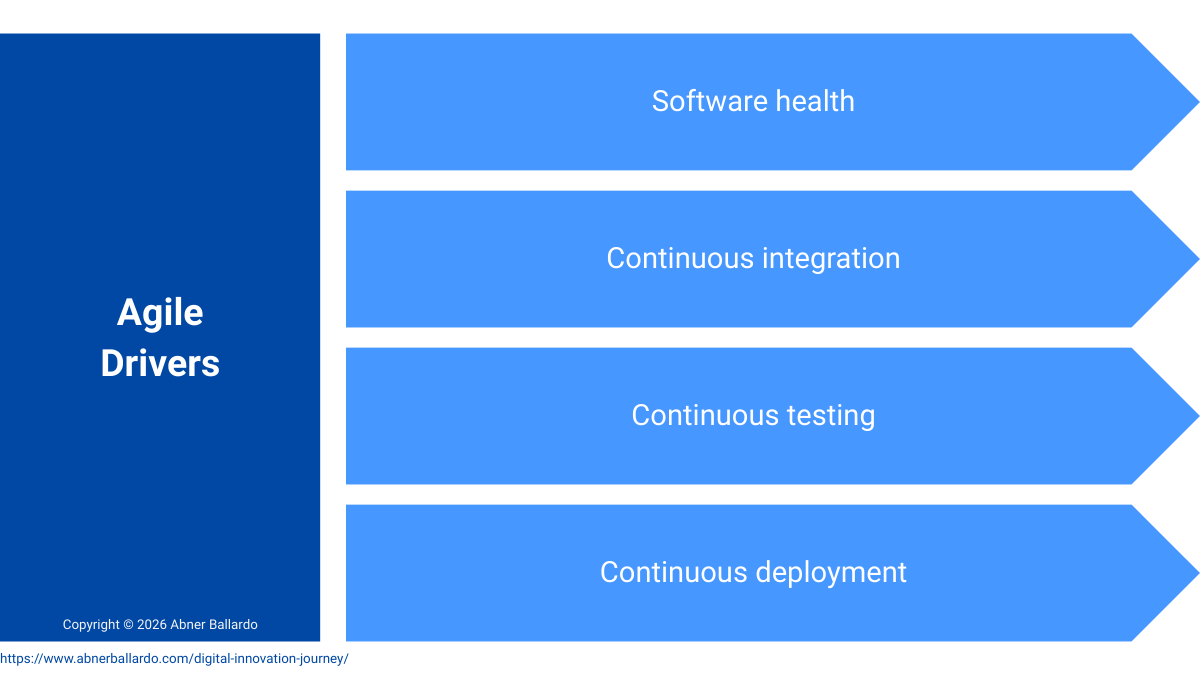
9. Agile Drivers: Optionality, Not Velocity
Agile Drivers are often misinterpreted as process concerns. They are not.
They govern the economic cost of change.
Software health, integration discipline, testing depth, and deployment capability determine how easily a product can adapt as conditions shift.
When these drivers are weak, change becomes expensive. Risk increases. Leaders slow down not by choice, but by necessity.
Paradoxically, organizations often accelerate feature delivery while eroding Agile Drivers, believing they are moving faster. In reality, they are spending future optionality to buy present speed.
This trade-off is rarely explicit. Its consequences are.
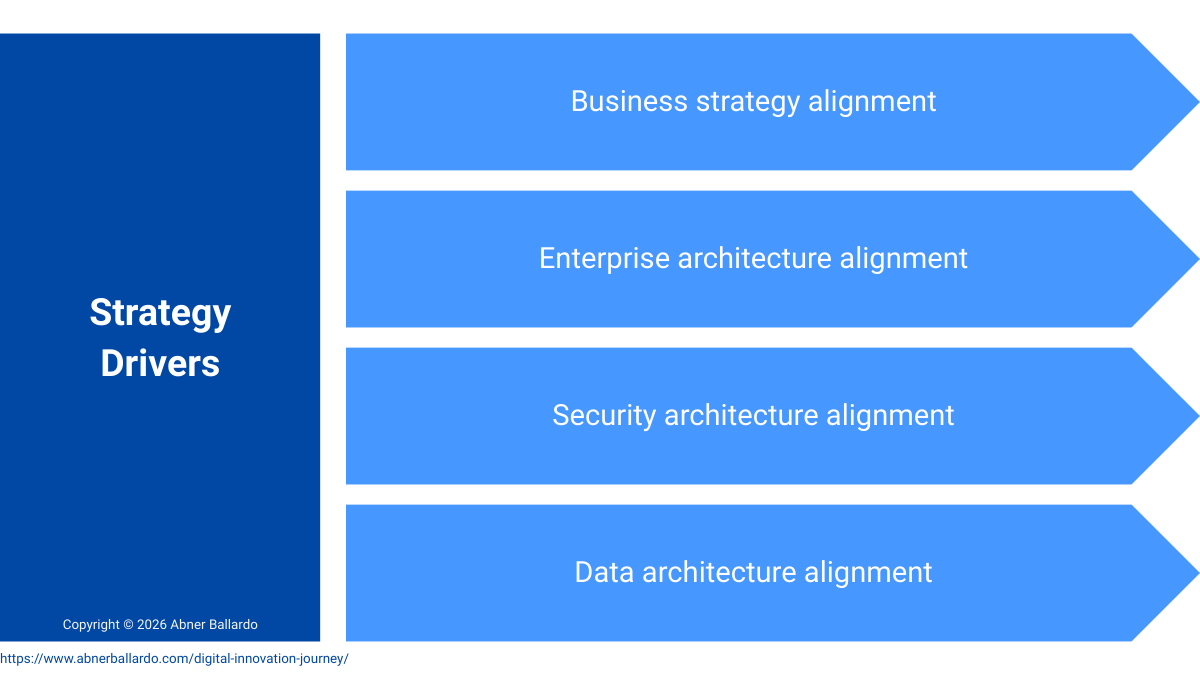
10. Strategy Drivers: Enterprise Constraints as Reality
Strategy Drivers define what is allowed to exist inside an organization.
They include alignment with business direction, enterprise architecture, security architecture, and data architecture.
Unlike Core Drivers, these forces do not exist to enable speed. They exist to impose boundaries.
When ignored early, Strategy Drivers reassert themselves later — often abruptly. Products that evolved in isolation collide with enterprise constraints after scale has already been achieved.
At that point, alignment is no longer a design choice. It becomes a retrofitting exercise under pressure.
This is not a failure of architecture. It is a failure of leadership to acknowledge constraints as real from the beginning.
11. Why Imbalance Is Predictable - and Dangerous
Imbalance across drivers is normal. Persistent imbalance is not.
Digital products naturally advance where attention is highest and resistance is lowest. Over time, this creates skewed structures that feel successful until they are tested.
The danger is not asymmetry itself. The danger is unrecognized asymmetry.
When leaders lack a way to see imbalance, they continue to invest in the most visible dimensions and defer the least visible ones. Eventually, the product becomes fast, popular, and fragile.
At that point, intervention is no longer optional — it is reactive.
The Digital Innovation Journey exists to make this pattern visible while correction is still possible.
Part IV - Seeing Structural Imbalance
Structural imbalance is rarely invisible. It is simply unobserved.
Most organizations do not lack data about their digital products. They lack a way to interpret what that data implies about long-term viability. Metrics accumulate. Dashboards multiply. Confidence increases.
Yet the signals that precede failure are rarely numerical. They are relational.
This section introduces the Digital Innovation Board as a way to surface those signals — not to diagnose, prescribe, or optimize, but to make imbalance impossible to ignore.
12. The Digital Innovation Board
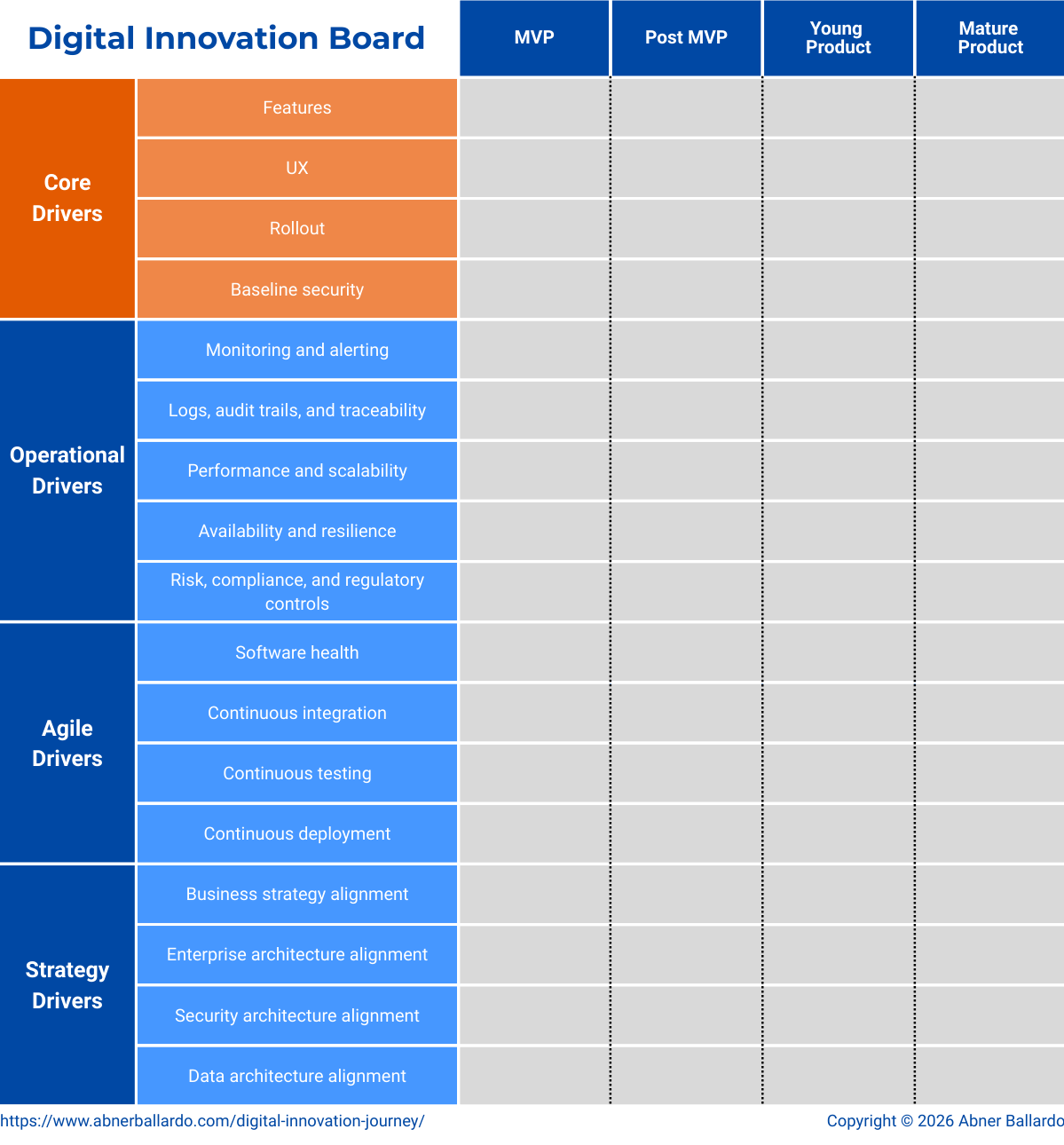
The Digital Innovation Board exists to reveal how a digital product is evolving across multiple dimensions at the same time.
It is not a planning tool. It is not a maturity model. It is not a governance mechanism. It does not assign scores, targets, or thresholds.
The board crosses two axes:
- Product states, representing how exposed the product has become over time
- Driver categories, representing the forces shaping that exposure
Each intersection reflects attention, investment, and intent — whether explicitly acknowledged or not.
What the board makes visible is not performance. It makes visible shape.
13. Why the Board Avoids Precision
The Digital Innovation Board deliberately avoids numeric scoring and comparative benchmarking.
Precision invites optimization. Optimization invites gaming. Gaming destroys recognition.
False accuracy provides comfort without insight. A product that scores well can still be structurally fragile if attention has advanced unevenly.
By remaining directional and qualitative, the board resists being turned into a performance artifact. Its value lies in what feels uncomfortable, not in what can be measured.
When leaders ask for scores, the board has already failed.
14. Shape Over Color
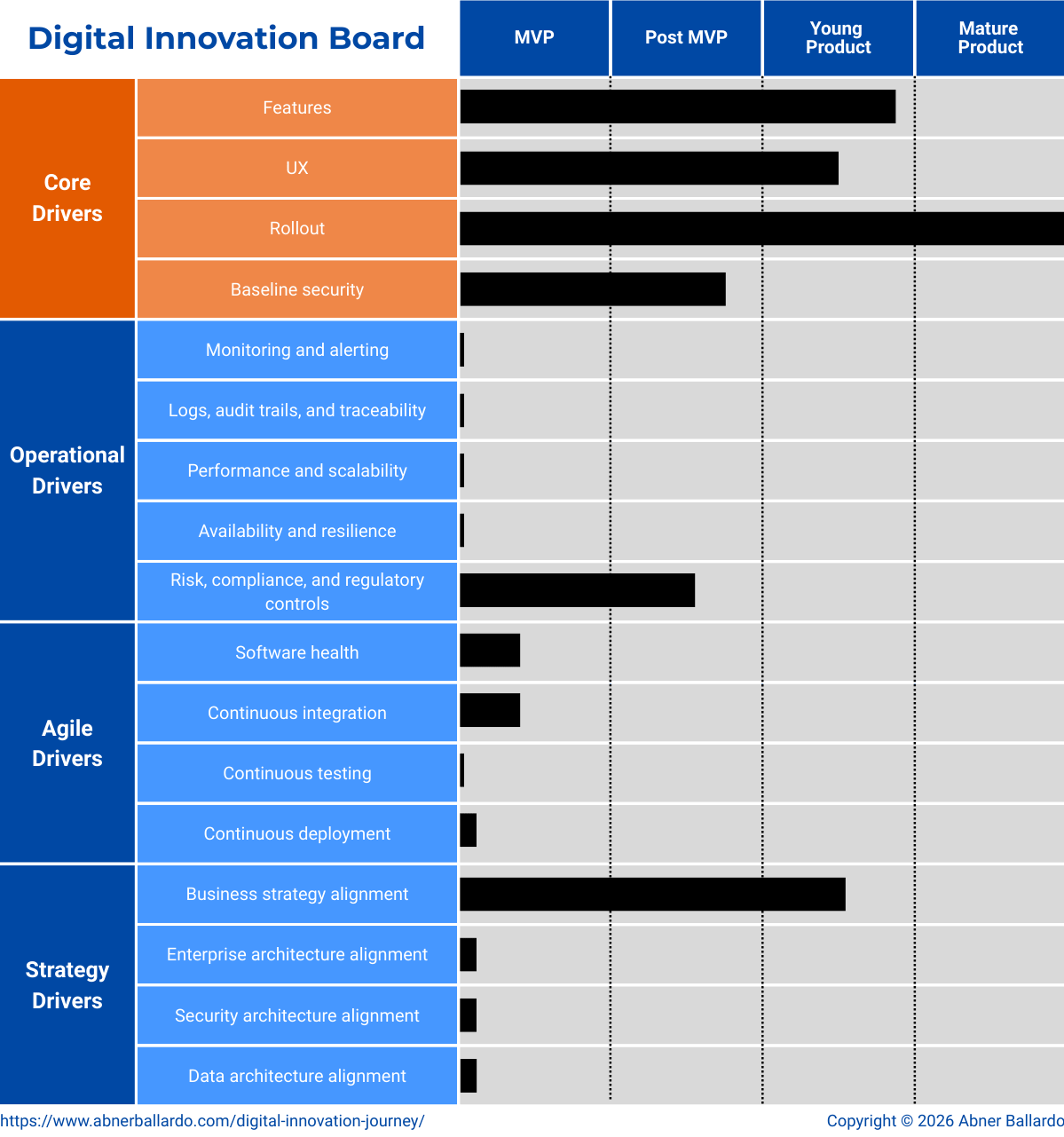
The most important signal on the board is not magnitude. It is form.
A balanced shape indicates that attention has evolved proportionally across dimensions. A distorted shape reveals where acceleration has outpaced support.
Color, emphasis, or intensity are secondary. They exist only to draw the eye, not to convey completion.
Leadership error often begins when color is interpreted as progress rather than as a directional cue.
The board is read as a whole, not cell by cell.
15. Persistent Gaps vs Temporary Asymmetry
All digital products exhibit asymmetry, especially early.
Temporary imbalance is expected when uncertainty is high and learning is prioritized. Persistent imbalance is different.
When the same dimensions lag across time while others continue to advance, the product is accumulating structural risk. The organization is no longer choosing where to invest; it is avoiding where to look.
The board does not judge this condition. It exposes it.
Recognition precedes action. Without recognition, action becomes reactive and expensive.
16. When Leadership Intervention Becomes Mandatory
Leadership intervention is not required when imbalance appears. It is required when imbalance is normalized.
The most dangerous moment is not when gaps are discovered, but when they are repeatedly acknowledged without consequence.
At that point, the board is no longer revealing risk. It is recording it.
The Digital Innovation Journey exists to ensure that this moment is seen clearly — before intervention becomes crisis management.
Part V - Decision Gates and Product Mortality
Seeing imbalance is not the goal. Deciding in response to it is.
Most organizations do not fail because they lack insight. They fail because insight does not translate into explicit decisions. Recognition without consequence merely extends the life of structural risk.
This section addresses the point at which observation must give way to ownership.
17. Decision Ownership Cannot Be Delegated
In digital products, decision ownership always resides with leadership, whether acknowledged or not.
Teams can surface signals. Functions can raise concerns. Committees can discuss options. None of them can own the consequences of continuing, stopping, or fundamentally changing a product.
When leadership avoids explicit ownership, decisions do not disappear. They default.
Continuation becomes the implicit choice. Investment persists. Scope expands incrementally. Over time, this default hardens into obligation.
At that point, the organization is no longer deciding. It is maintaining momentum to avoid confronting past choices.
18. The Default Continuation Trap
Every digital product continues unless someone explicitly decides otherwise.
This trap is rarely visible because continuation feels neutral. There is no announcement, no justification, no moment of commitment.
Yet continuation is the most consequential decision an organization can make. It compounds exposure, consumes optionality, and converts temporary imbalance into permanent structure.
Products that should have been stopped early rarely fail outright. They persist long enough to become politically and operationally expensive to unwind.
By the time continuation is questioned, stopping is framed as failure.
19. Killing Products as a Leadership Outcome
Stopping a digital product is not an admission of failure. It is a demonstration of judgment.
Products exist to test hypotheses, create value, or support strategic intent. When those conditions no longer hold, continuation becomes wasteful.
Organizations that cannot kill products early are not cautious. They are indecisive.
Early termination protects focus, preserves credibility, and prevents structural debt from metastasizing. Late termination does the opposite.
The true cost of not killing is rarely visible on a balance sheet. It appears later as fragility, reputational damage, and forced investment under pressure.
20. Decision Gates as Moments of Irreversibility
Certain moments in a product’s life are more consequential than others.
Crossing them does not simply add cost; it removes options.
Scaling beyond initial exposure, embedding into core operations, or committing to regulatory permanence are not technical milestones. They are leadership decisions that narrow the future.
When these gates are crossed without explicit acknowledgment, the organization drifts into irreversible commitment.
The danger is not making these decisions. The danger is making them accidentally.
21. Mortality as a Structural Property
All digital products have a natural lifespan, even if it is never formally declared.
Pretending otherwise turns products into liabilities. Refusing to acknowledge mortality converts learning into sunk cost.
Organizations that endure are not those that avoid endings. They are those that institutionalize them.
Product mortality is not a delivery concern. It is a leadership responsibility.
Part VI - Regulated and High-Consequence Environments
Digital products do not operate in a vacuum. In regulated and high‑consequence environments, structural imbalance is not merely inefficient — it is amplified.
Constraints arrive earlier. Scrutiny is continuous. The cost of correction is higher, and the tolerance for improvisation is lower.
This section does not introduce new principles. It clarifies why existing ones become unavoidable.
22. Why Regulation Amplifies Structural Imbalance
Regulation does not create risk. It exposes it.
Controls, audits, and supervisory reviews do not introduce new requirements into a digital product. They surface whether foundational decisions were made explicitly or deferred.
In lightly regulated environments, imbalance can persist quietly. In regulated ones, it becomes visible under formal scrutiny.
When operational, architectural, or data foundations are weak, regulation does not slow the product — it stops it.
At that point, the organization is no longer managing risk. It is responding to it under pressure.
23. Compliance as an Operational Reality
In high‑consequence environments, compliance is not advisory.
Controls must execute continuously. Evidence must be produced on demand. Failures are not hypothetical; they are recordable.
Treating compliance as a late‑stage overlay is a common leadership error. It assumes that control can be added without reshaping the system that must enforce it.
When this assumption fails, teams are forced to compensate with manual processes, workarounds, and exceptions. The product continues to operate, but its structural integrity erodes.
This is not a compliance problem. It is a decision problem.
24. Approval Cultures and the Illusion of Safety
Highly regulated organizations often substitute approval for ownership.
Reviews multiply. Sign‑offs accumulate. Responsibility diffuses.
While approvals create a sense of safety, they rarely change the underlying structure of a product. They validate intent, not viability.
When accountability is distributed across committees, no one owns the consequence of continuation. Risk becomes collective, which effectively means it becomes no one’s.
True safety in regulated environments does not come from more approvals. It comes from explicit, durable decisions.
25. Late Hardening as an Executive Failure
Many regulated products fail not because they move too fast, but because they harden too late.
Controls, observability, resilience, and architectural alignment are deferred in the name of speed. When scale or scrutiny arrives, these dimensions must be added under constraint.
Late hardening is expensive, disruptive, and often incomplete. It introduces fragility precisely where stability is expected.
This outcome is predictable. It is the result of leadership choosing visibility over durability early on.
Part VII - Leadership Posture
Frameworks do not fail. Leaders do.
Not through incompetence, but through discomfort with ambiguity, conflict, and irreversible choices.
The Digital Innovation Journey ultimately exposes posture, not process.
26. Comfort With Temporary Imbalance
Healthy digital products are not perfectly balanced.
Early asymmetry is often necessary to learn quickly and allocate resources effectively. The leadership failure is not allowing imbalance to exist — it is refusing to see when it has persisted too long.
Leaders who demand balance too early slow learning. Leaders who ignore imbalance too long create fragility.
Judgment lies in knowing the difference.
27. Slowing Down as an Executive Act
Deceleration is often misinterpreted as hesitation.
In reality, slowing down at the right moment is an assertion of control. It preserves optionality, forces trade‑offs into the open, and prevents irreversible commitments from being made accidentally.
Leaders who cannot slow down are not fast. They are constrained.
Speed without discretion is not agility. It is exposure.
28. What the Digital Innovation Journey Ultimately Exposes
The quality of a digital product is a reflection of leadership judgment over time.
Clarity over continuation.
Ownership over diffusion.
Courage over momentum.
The Digital Innovation Journey does not prevent failure. It makes the decisions that lead to failure visible — early enough to change them.
That visibility is its only promise.
Appendix - Boundary Conditions
This appendix exists to prevent misinterpretation.
The Digital Innovation Journey is deliberately narrow. Its value depends on what it refuses to do as much as on what it reveals.
A. What the Digital Innovation Journey Will Never Answer
The Digital Innovation Journey does not explain how to build, deliver, or operate digital products.
It will never answer questions such as:
- How should teams be structured?
- Which methodology should be used?
- What tools, platforms, or vendors are appropriate?
- How should roadmaps, backlogs, or delivery plans be constructed?
- How can speed, quality, or productivity be improved?
These questions are contextual, situational, and transient. Answering them publicly would convert judgment into instruction.
The absence of these answers is intentional.
B. What the Digital Innovation Journey Does Not Optimize
The Digital Innovation Journey does not optimize for:
- Delivery efficiency
- Time to market
- Feature throughput
- Cost reduction
- Team performance
Optimization assumes a stable objective function. Digital products rarely have one.
When optimization becomes the goal, decision quality deteriorates. Leaders focus on improving metrics rather than confronting trade-offs.
DIJ exists to surface those trade-offs, not to resolve them.
C. What the Digital Innovation Journey Is Not a Substitute For
The Digital Innovation Journey does not replace:
- Product management
- Architecture practices
- Risk management
- Security engineering
- Compliance functions
These disciplines remain necessary. They do not disappear because judgment is clarified.
DIJ does not compete with them. It exposes when leadership expects them to compensate for undecided or deferred choices.
D. Common Misreadings to Avoid
The following interpretations indicate misuse:
- Treating DIJ as a maturity model
- Expecting a checklist or assessment score
- Using the Digital Innovation Board as a performance tool
- Asking how to “implement” DIJ
- Delegating DIJ interpretation to teams or functions
When these misreadings appear, authority has already eroded.
E. When DIJ Should Not Be Used
The Digital Innovation Journey is not universally applicable.
It should not be used when:
- The system is not a digital product
- The initiative is purely experimental with no intent to scale
- Leadership is unwilling to own stop-or-continue decisions
- Failure is reversible without material consequence
Applying DIJ where these conditions are not met creates noise without insight.
F. The Final Boundary
The Digital Innovation Journey does not guarantee better outcomes.
It guarantees only one thing: that the decisions shaping those outcomes are visible.
Whether leaders act on that visibility is outside its scope.
Intellectual Property and Use
This Digital Innovation Journey Manual is the original work and intellectual property of Abner Ballardo. Copyright © 2026 Abner Ballardo.
All rights reserved. This manual may not be reproduced, distributed, or transmitted in any form or by any means without prior written permission. Limited citations and references are allowed when crediting the author and linking to the original source.
For commercial use, adaptations, or any use beyond fair use, please contact Abner Ballardo directly for authorization.
This manual is derived from the Digital Innovation Journey — a decision lens for exposing leadership choices that shape digital product outcomes long before failure becomes visible.